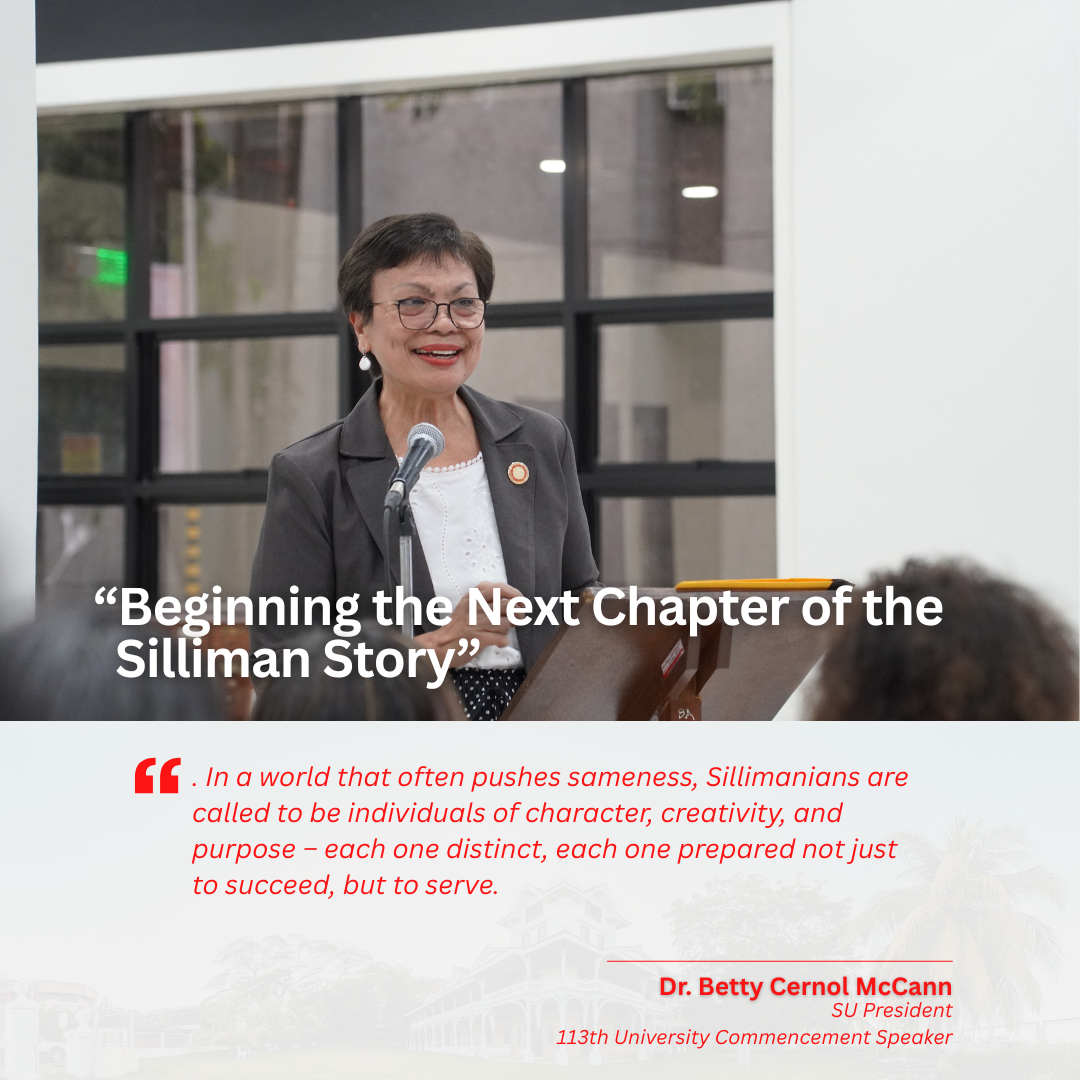
Beginning the Next Chapter of the Silliman Story
Look at you in your caps and gowns.. What emotions could you be in right now – relief, pride, joy? Perhaps for some of you, the quiet question: “What happens next?” May I invite you to consider reflecting on – beginning the next chapter of your Silliman story.
Good afternoon graduates, parents, university policymakers, faculty and staff, alumni, and friends.
Commencement is always a beautiful moment in the life of a university. Parents look at their children with pride. Faculty members see the fruit of years of mentoring. And graduates feel a mixture of joy, relief, excitement—and perhaps a little uncertainty about what comes next.
Like you, with my impending stepping down from my administrative journey, it feels like I am graduating from my role as a learner in the field of administration in higher education. And after about three decades of amassing answers to examinations in my field of work, I realize that the questions may have changed and I may need to search for other sets of answers. But, of course, today as graduation day, is not only about what knowledge was acquired but about who one has become and what one has learned to care- not just about success, but about meaning and life purpose.
So, dear graduates, today is not only about what you have completed.
The word commencement means beginning. So today is really about the next chapter of your life—and about how that chapter becomes part of a much larger story. And that story began here in Dumaguete more than a century ago. In 1901, a young missionary educator named David Sutherland Hibbard arrived in this quiet seaside town to open what was then called the Silliman Institute. The school began with only a handful of boys in bamboo classrooms. There were no grand facilities, no large endowments, and no guarantee that the school would survive. But there was a powerful vision: that education grounded in Christian faith could transform lives and communities.
Alongside David Hibbard in this early mission was his wife, Laura Hibbard. Laura was not only a supportive partner in the mission. She was an educator in her own right and a mentor to many students, especially young women. In a time when educational opportunities for women were still limited in many places, she believed strongly that women should be educated—not only academically but also morally and spiritually—so they could contribute meaningfully to society. Students remembered her not only as a teacher, but as someone who listened, encouraged, and believed in their potential.
Together, David and Laura Hibbard helped nurture a community where education meant forming the whole person—mind, heart, and spirit. That vision took physical shape in the buildings that soon rose on this campus. One of them still stands today—quietly watching generations of students pass by. Silliman Hall, built in 1909, is often described as the oldest American structure in the Philippines. But its significance is not simply architectural. Inside its wooden walls, countless students once gathered to learn, to listen, to ask questions, and to discover their place in the world. Imagine those early classrooms: wooden floors, open windows letting in the sea breeze, students eager to learn in a newly opened institution. Those simple spaces helped launch a tradition of education that would reach far beyond Dumaguete.
Another structure also played an unexpected role in the early life of the school. The Silliman Gymnasium, which today hosts athletic events and university gatherings, once served a surprising purpose. In the early years of aviation in the Philippines, the gymnasium even functioned as a hangar for small aircraft. It is a remarkable image: a university gymnasium by the sea sheltering one of the earliest airplanes to land in the region. That story captures something about the spirit of this institution. From the very beginning, Silliman was not afraid to engage with new ideas, new technologies, and new possibilities—while remaining grounded in faith and service.
Over the decades, the small Silliman Institute grew into what we now know as Silliman University. Its mission expanded, but its core vision remained the same: to educate the whole person for the good of society and the care of God’s creation. That vision eventually came to be expressed in what Sillimanians often describe as the four pillars of the university: Faith. Instruction. Research. Extension.
- Faith reminds us that knowledge must be guided by moral purpose and spiritual grounding.
- Instruction represents the daily work of teaching and learning that forms the mind.
- Research reflects the university’s commitment to discovering new knowledge and addressing real problems in society.
- Extension reminds us that education must reach beyond campus walls—serving communities, empowering people, and improving lives.
These four pillars define what makes Silliman distinctive. They remind us that a university is not simply a place where information is delivered. It is a community that shapes lives and serves the world.
You know, Ken Robinson once said that many schools today operate like a “fast food model” – standardized, efficient, and designed to produce the same results from everyone.
But education is not fast food. It is deeply human. And here in Silliman University, we have always known that.
From the time of David Sutherland Hibbard and Laura Hibbard, education was never meant to be about uniformity. It was about formation – faith, instruction, research, and service – shaping not just minds, but lives.
Robinson offers a better image: education as cultivation. You don’t force growth – you nurture it. You create the conditions where each person can thrive in their own way.
And that is our continuing task today, individually and as a community. In a world that often pushes sameness, Sillimanians are called to be individuals of character, creativity, and purpose – each one distinct, each one prepared not just to succeed, but to serve.
Graduates, during your years here, you have experienced these pillars of learning in many ways. You encountered faith in chapel services, in quiet moments of reflection, and in conversations about meaning and purpose. You received instruction in classrooms, laboratories, studios, and fieldwork. You saw research as faculty and students sought solutions to complex problems. And through community engagement and outreach, you witnessed extension—education reaching beyond campus to serve society. These experiences were not separate pieces of your education. They were part of a single vision: whole-person development. And that vision is urgently needed today.
We are living through a period of profound transformation in education and society. Digital technologies are reshaping how knowledge is created and shared. Artificial intelligence is changing the nature of work. Global challenges—from climate change to public health—require collaboration across nations and disciplines. Universities everywhere are asking: how do we prepare students for a future that is constantly evolving?
We live in a world of extraordinary achievements. Technology connects people instantly across continents. Scientific discoveries open new possibilities for health, communication, and innovation. Yet the world also faces serious challenges. Communities struggle with inequality. Public discourse is often divided. And the natural environment reminds us that human progress must be balanced with care for creation. The question before your generation is not simply: What can we accomplish? The deeper question is: What kind of world will our accomplishments create?
That question brings us back to the vision of the founders. When David and Laura Hibbard began their work here, they believed education should produce not only skilled professionals, but responsible citizens and compassionate leaders. People who understand that knowledge carries responsibility. People who see their work as a form of service. People who recognize that caring for society and caring for the earth are deeply connected.
Graduates, the degrees you receive today represent years of dedication. But the true measure of your education will not only be what you achieve. It will be how your life contributes to the flourishing of others. Perhaps you will design technologies that improve lives. Perhaps you will teach and inspire future generations. Perhaps you will help communities become more just, more compassionate, and more sustainable. Whatever path you follow, remember that your education here carries a legacy. It carries the vision of David and Laura Hibbard. It carries the quiet witness of Silliman Hall. It carries the adventurous spirit symbolized by a gymnasium that once sheltered an airplane. And it carries the enduring commitment to faith, instruction, research, and extension.
Graduates, today you step into the next chapter of this story. The world you enter will need people who combine knowledge with wisdom, achievement with humility, and ambition with compassion. In the words of the prophet Micah, God asks us: “To act justly, to love mercy, and to walk humbly with your God” (Micah 6:8). If you live those words—if you pursue excellence while serving others—then the education you received here will continue to bear fruit far beyond this campus. And one day, future generations of Sillimanians may look back and say that the graduates of this class helped build a world that was wiser, kinder, and more faithful to God’s call.
So as you leave this campus today, carry the story forward. Carry the faith that shaped this institution. Carry the responsibility that comes with knowledge. And carry the hope that your life can help bring healing and renewal to the world.
Congratulations, Class of 2026. May your journey be like that of a Presbyterian servant- one whose faith is alive with energy, guided by imagination, and grounded in love – serving not only with hands that act, but with a heart that cares, and a mind that envisions a better world.
Thank you—and God bless each one of you.


