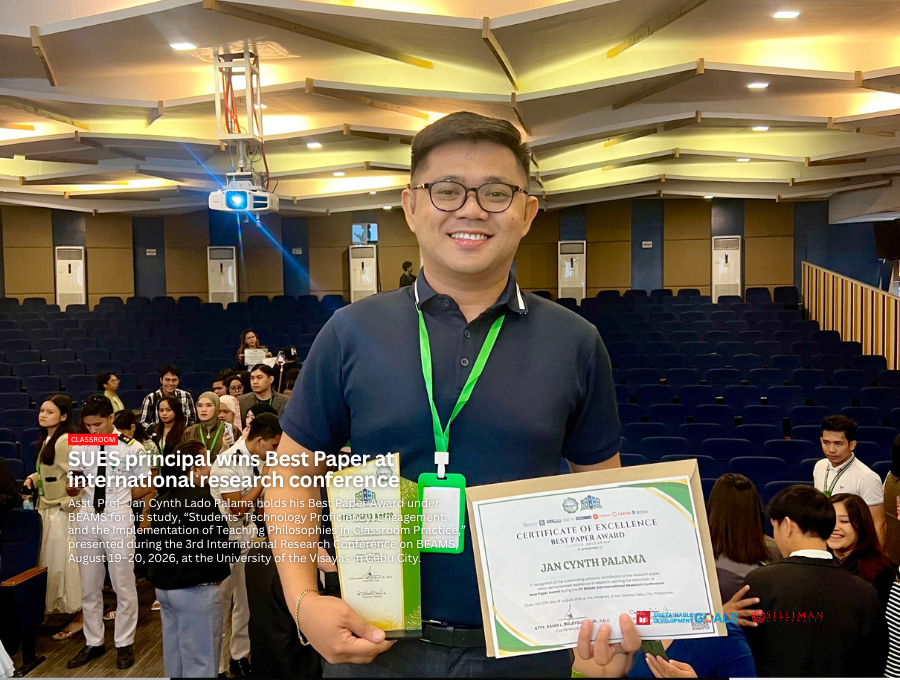
SUES principal wins Best Paper at international research conference
Asst. Prof. Jan Cynth Lado Palama, principal of the Silliman University (SU) Elementary School and a Doctor of Philosophy in Education major in Research and Evaluation student of SU, received the Best Paper Award under BEAMS during the 3rd International Research Conference on BEAMS, held August 19–20, 2026, at the Inday Teresing Auditorium, University of the Visayas Main Campus in Cebu City.
Hosted by the University of the Visayas, the conference carried the theme, “Harnessing Research Frontiers: Innovation, Emerging Technologies, and Transformative Inquiry,” and gathered researchers and educators to present scholarly work addressing emerging issues, innovations, and transformative approaches across various fields.
Palama received the award for the paper, “Students’ Technology Proficiency, Engagement, and the Implementation of Teaching Philosophies in Classroom Practice.” The study examines students’ proficiency and engagement with technology and how technology engagement relates to the teaching philosophies observed in classroom practice.
Using a descriptive-correlational research design, the study involved College of Education students and examined six educational philosophies: essentialism, perennialism, progressivism, constructivism, reconstructionism, and existentialism. It also investigated whether students’ technology engagement has a statistically significant association with the implementation of these philosophies in the classroom.
The study found that students were generally very proficient in using technology and highly engaged in technology-supported learning. Among the areas where students demonstrated particularly strong engagement was the use of digital tools for collaboration with classmates.
Results also showed significant associations between students’ technology engagement and learner-centered teaching philosophies, particularly progressivism and constructivism. Reconstructionism was likewise found to have a significant association with technology engagement. In contrast, no significant associations were found with essentialism, perennialism, and existentialism.
The findings suggest that while technology can support interactive, collaborative, and learner-centered approaches, it does not by itself determine how teachers approach instruction. Rather, technology serves as a tool that can complement different teaching philosophies and pedagogical practices.


