Silliman nursing student researchers present AI and health-seeking behavior study at ADPCN conference
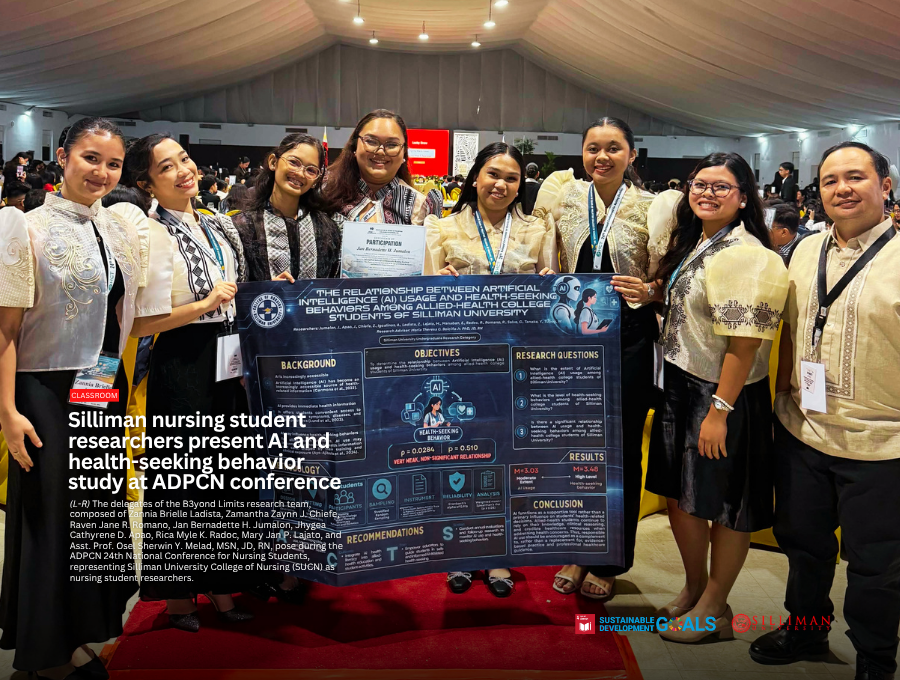
Delegates from the B3yond Limits research team of Silliman University College of Nursing (SUCN) participated in the Association of Deans of Philippine Colleges of Nursing, Inc. (ADPCN) 24th National Conference for Nursing Students on October 4, 2026, at The Tent City, The Manila Hotel, Philippines, presenting research on the relationship between artificial intelligence (AI) usage and health-seeking behaviors among allied-health students.
Titled “The Relationship Between Artificial Intelligence (AI) Usage and Health-Seeking Behaviors Among Allied-Health College Students of Silliman University,” the undergraduate research examined whether the extent of AI usage was associated with students’ health-seeking behaviors during Academic Year 2025–2026.
The study employed a quantitative descriptive-correlational research design involving 540 students from SU, including the College of Nursing, the Institute of Clinical and Laboratory Sciences (ICLS), the Institute of Rehabilitative Sciences (IRS), the Pharmacy Department, and the Nutrition and Dietetics (ND) Department.
Using a modified questionnaire adapted from established health-seeking behavior scales, the researchers assessed AI usage and health-seeking behaviors and analyzed their relationship using Spearman’s rank-order correlation coefficient.
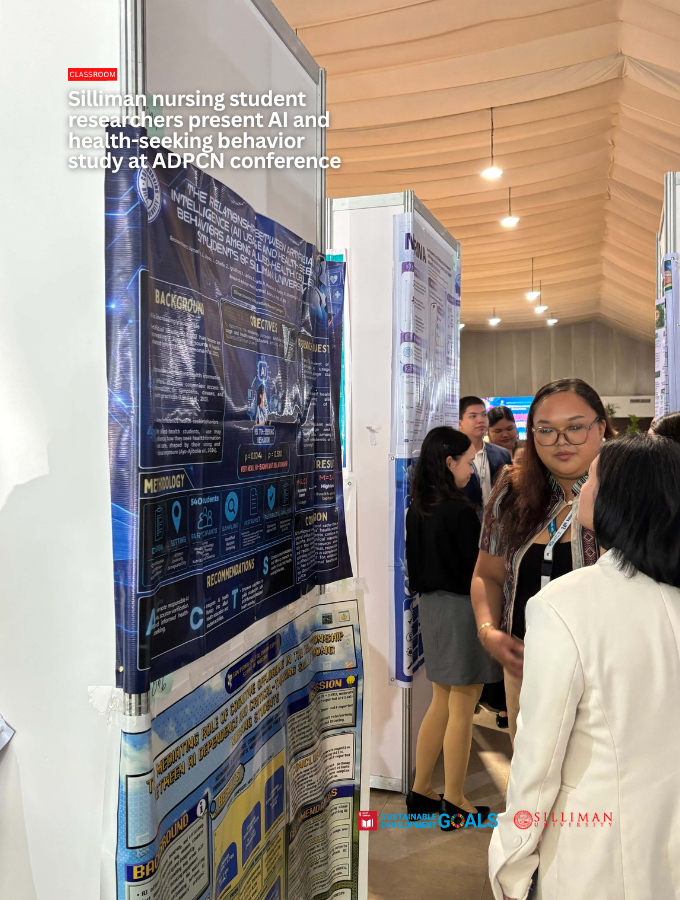
Jan Bernadette H. Jumalon presents and explains their research poster during the ADPCN 24th National Conference for Nursing Students, representing Silliman University College of Nursing.
The findings showed that despite moderate AI usage, the students demonstrated a high level of health-seeking behaviors.
However, the relationship between AI usage and health-seeking behaviors was extremely weak and statistically insignificant (ρ = 0.0284; p = 0.510), indicating that AI usage was not predictive of students’ health-seeking behaviors.
The researchers emphasized that access to AI technology does not automatically translate into informed health-seeking behavior.
The study highlighted the importance of equipping future health professionals with the skills to critically evaluate information, verify sources, recognize technological limitations, apply evidence-based reasoning, and make ethical decisions.
It also underscored that AI should support, rather than replace, human judgment in nursing practice.
The SUCN delegation at the conference included nursing student researchers Zannia Brielle Ladista, Zamantha Zaynn J. Chiefe, Raven Jane R. Romano, Jan Bernadette H. Jumalon, Jhygea Cathyrene D. Apao, Rica Myle K. Radoc, and Mary Jan P. Lajato, together with Asst. Prof. Osel Sherwin Y. Melad, MSN, JD, RN.
The conference, themed “The Future of Nursing Education in the Age of Artificial Intelligence and Simulation-Based Education,” featured three plenary speakers, fireside chats with invited speakers from various institutions, and around 100 poster presentations selected from more than 300 applications.
Organized by ADPCN, the annual conference serves as a national platform for nursing students to exchange ideas, disseminate research, and engage with developments in nursing education and practice.


