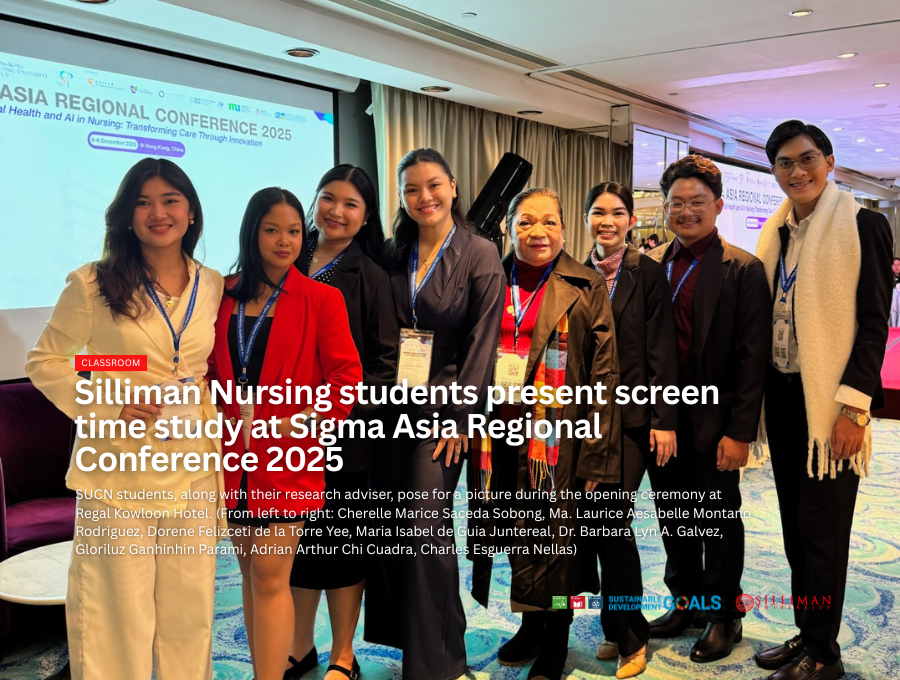
Silliman Nursing students present screen time study at Sigma Asia Regional Conference 2025
Students from the Silliman University College of Nursing (SUCN) presented a qualitative research study examining the effects of screen time on preschool children at the Sigma Asia Regional Conference 2025, held on December 5–6 in Kowloon, Hong Kong.
The conference, themed “Digital Health and AI in Nursing: Transforming Care Through Innovation,” brought together more than 550 nursing leaders, practitioners, researchers, and scholars from 19 countries and regions to exchange insights on emerging trends in nursing education, research, and practice.
The Silliman delegation was composed of Level IV student researchers Adrian Arthur Chi Cuadra, Maria Isabel de Guia Juntereal, Charles Esguerra Nellas, Gloriluz Ganhinhin Parami, Ma. Laurice Aesabelle Montano Rodriguez, Cherelle Marice Saceda Sobong, and Dorene Felizceti de la Torre Yee.
Their paper, “Perceived Beneficial and Adverse Consequences of Screen Time on Preschool Children and Recommendations of Caregivers: A Qualitative Descriptive Study,” explored caregivers’ perspectives on children’s screen use, identifying both its perceived benefits and risks across cognitive, emotional, social, and physical development domains.
Using a qualitative descriptive design, the study employed in-depth interviews to document caregivers’ lived experiences and daily observations, taking into account parenting styles and cultural attitudes toward technology. Thematic analysis yielded nine major themes: four highlighting perceived benefits such as improved language and communication, cognitive and academic skills, emotional and moral development, and critical thinking with real-life application of digital media; two reflecting negative effects including physiological concerns like eye strain, headaches, and sleep disturbances, as well as psychosocial and behavioral challenges; and three emphasizing caregiver recommendations, particularly active supervision, engagement in physical and constructive alternative activities, and health-based rationales for limiting screen exposure.
The findings underscore that while screen time may support early learning and digital literacy, excessive or unregulated exposure can contribute to emotional dysregulation and imitation of inappropriate behaviors. Caregivers consistently emphasized the importance of structured guidance, time limits, and balancing digital activities with physical play and social interaction.
The student researchers were guided by their research adviser, Dr. Barbara Lyn A. Galvez.
Also representing SU was Dr. Maria Theresa C. Belciña Jr., president of the Psi Beta Chapter, who attended the conference and served as one of the judges for the Best Oral Research Presentations. Her involvement in the Sigma Asia Region President’s Circle dates back to 2018, when Silliman University hosted the Asia Regional Conference, reflecting the institution’s sustained engagement in regional nursing leadership and scholarship.
In addition, Asst. Prof. Marnesa Campoy of the College of Nursing presented her study titled “The Theory of Post-Widowhood Transformation in Older Persons,” further strengthening the university’s scholarly presence at the international forum.
Conference activities included plenary sessions, keynote lectures, and concurrent oral and poster presentations, with morning sessions held at the Regal Kowloon Hotel and afternoon sessions at the Hong Kong Polytechnic University School of Nursing. The hosts—the Sigma Pi Iota At-Large Chapter and The Hong Kong Polytechnic University—provided free accommodation to the 10-member Silliman University delegation in support of student participation in international scholarly exchange.
Through their participation, the SUCN students contributed to regional conversations on digital health and child well-being, highlighting the role of nursing research in promoting evidence-based caregiving practices amid the growing influence of digital technologies in early childhood.


