SU ComSci students present Hiligaynon language model at int’l conference
Two fourth-year Computer Science students from Silliman University presented a pioneering study on the Hiligaynon language at an international academic conference on computational linguistics held in Vietnam.
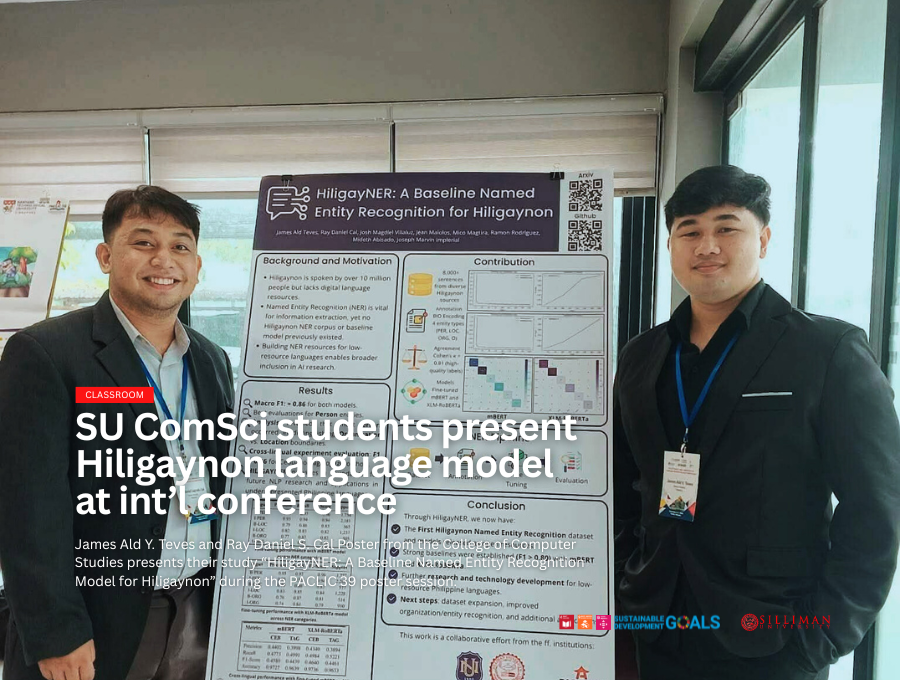
James Ald Y. Teves and Ray Daniel S. Cal of the College of Computer Studies presented their paper, “HiligayNER: A Baseline Named Entity Recognition Model for Hiligaynon,” at the 39th Pacific Asia Conference on Language, Information and Computation (PACLIC 39), held from December 5 to 7, 2025 at the Vietnam Institute for Advanced Study in Mathematics (VIASM) in Hanoi, Vietnam.
The study addresses the limited representation of Philippine regional languages in natural language processing research by introducing HILIGAYNER, the first publicly available Named Entity Recognition (NER) corpus and baseline models for Hiligaynon. The dataset contains over 8,000 annotated sentence-level entities compiled from online news articles, social media posts, and translated texts, filling a critical resource gap for low-resource language research.
Using fine-tuned multilingual transformer-based models—mBERT and XLM-RoBERTa—the researchers reported strong performance, with both models achieving over 80 percent precision, recall, and F1-score. Cross-language evaluations further demonstrated the model’s potential applicability to other Philippine and regional languages.
PACLIC 39 served as an international platform for scholars, researchers, and students to present peer-reviewed studies in computational linguistics, natural language processing, and language technologies, with particular emphasis on Asia-Pacific and low-resource languages.
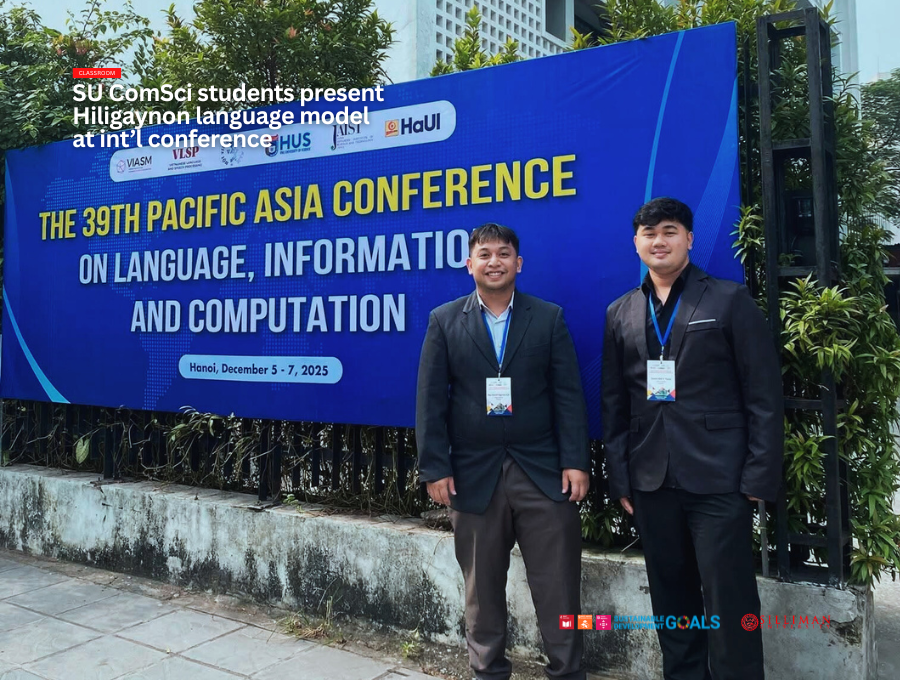
Teves and Cal pose at the Vietnam Institute for Advanced Study in Mathematics (VIASM), the host venue of the PACLIC 39.
Teves and Cal presented their work through a poster session, where they engaged in academic discussions, responded to questions, and exchanged insights with researchers from various institutions and countries.
The students shared that the conference experience was both enriching and affirming, noting that feedback from international researchers provided valuable perspectives for further improving their work. Participation in the conference also exposed them to global research standards and strengthened their motivation to pursue continued research in language technology and computational linguistics.
The presentation highlights Silliman University’s growing contribution to research on underrepresented Philippine languages and its support for student-led scholarship with international impact.


