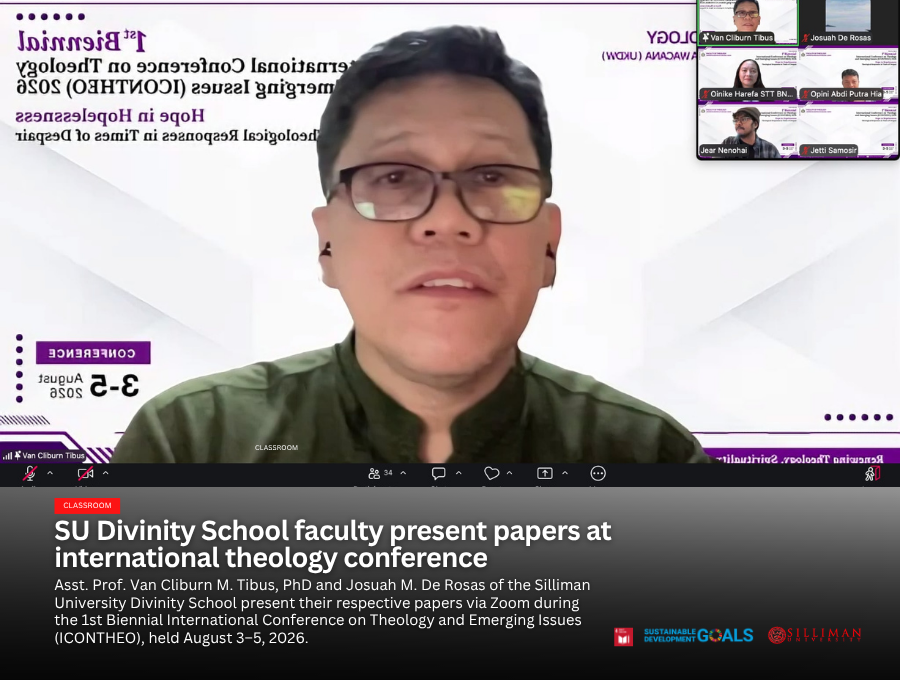
SU Divinity School faculty present papers at international theology conference
Two faculty members of the Silliman University (SU) Divinity School presented papers at the 1st Biennial International Conference on Theology and Emerging Issues (ICONTHEO), held online from August 3 to 5, 2026.
Asst. Prof. Van Cliburn M. Tibus, Ph.D., and Josuah M. De Rosas joined theologians and scholars from different parts of the world at the conference organized by the Faculty of Theology of Universitas Kristen Duta Wacana in Indonesia. The three-day gathering carried the theme, “Hope in Hopelessness: Theological Responses in Times of Despair.”
Tibus presented his paper, “Resisting Empire: Hope and Mission in Revelation,” which examines the Book of Revelation as a source of hope amid political uncertainty, inequality, social unrest, and other forms of systemic injustice.
Using postcolonial and contextual hermeneutics, Tibus rereads Revelation as a “counter-imperial text” rooted in the experience of marginalized communities under Roman domination. His study argues that the biblical text exposes imperial ideology while calling Christian communities to faithful resistance through their witness to Jesus Christ.
The paper further proposes a form of hope that goes beyond passive expectation. Tibus argues that Revelation’s vision of redemption calls believers to active participation in the Missio Dei, with mission understood as embodied resistance and faithful action grounded in God’s redemptive purposes for creation.
Meanwhile, De Rosas presented “‘Pamalandong,’ In the Shade: Spiritual Care for the Terminally Ill and the Dying in a Filipino Context.”
His paper examines the long-standing influence of Elisabeth Kübler-Ross’s stages of dying while recognizing criticisms that the model may oversimplify the complex experience of dying and may not adequately reflect diverse cultural contexts. De Rosas proposes pamalandong, a Filipino reflective practice, as a culturally grounded approach to end-of-life spiritual care.
Rooted in a Filipino collectivist worldview, pamalandong emphasizes meaning-making through relationships, community, and faith. The approach uses Kübler-Ross’s stages as a flexible backdrop rather than a linear process, allowing dying persons to integrate their life experiences into a meaningful narrative while offering a culturally responsive framework for families, chaplains, healthcare practitioners, and institutions.
ICONTHEO 2026 gathered participants from the Philippines, Indonesia, Malaysia, Singapore, Taiwan, Kenya, Nigeria, the United States, Canada, the United Kingdom, Croatia, Romania, Amsterdam, and Poland. A total of 56 presenters were organized into 20 panels, with three keynote speakers featured each day.
The conference sought to bring multiple perspectives, including those from interfaith and interdisciplinary contexts, into conversations on how theology can respond to contemporary global challenges. It also provided a space for cross-contextual dialogue on the possibilities of sustaining hope amid experiences of despair.


