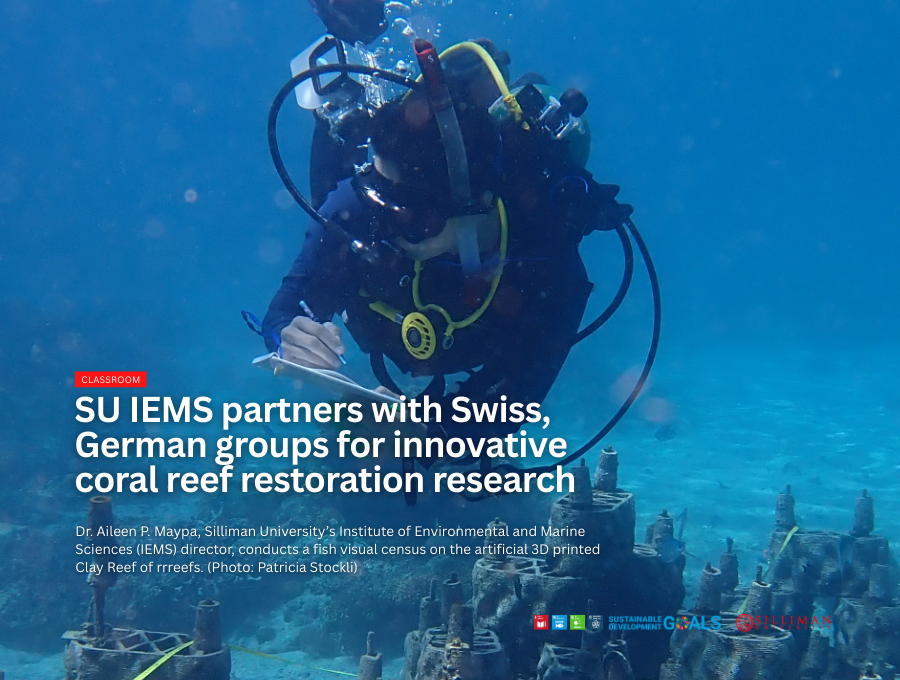
SU IEMS partners with Swiss, German groups for innovative coral reef restoration research
The Silliman University Institute of Environmental and Marine Sciences (SU-IEMS) is taking a lead role in an international collaboration with rrreefs, a Zurich-based Swiss corporation and German NGO, to advance innovative coral reef restoration research in the Philippines.
A year ago, rrreefs installed a 3D-printed artificial reef structure made of non-toxic, pH-neutral clay in the Milalunan Marine Sanctuary in Maria, Siquijor. The modular system, designed to enhance coral settlement and growth, forms part of a long-term experiment evaluating its effectiveness as a restoration tool, according to rrreefs Head of Operations and Scientific Partnerships, Hanna Kuhfuss.
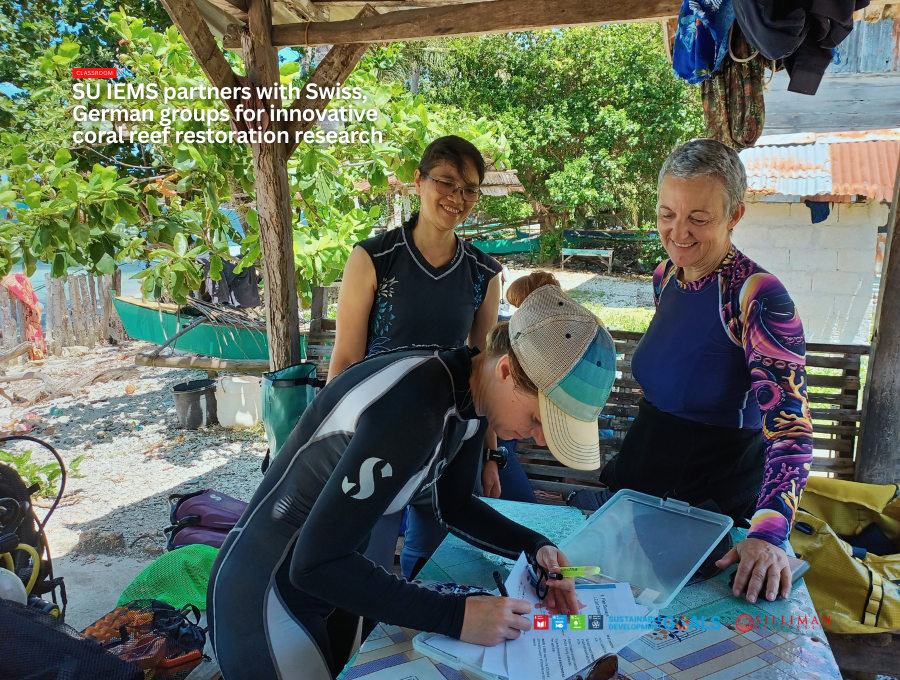
Hanna Kuhfuss, rrreefs Head of Operations and Scientific partnerships (left), Dr. Aileen Maypa (center) and Patricia Stockli (right). (Photo: Jhon Reimer Fajardo)
SU-IEMS joined the bi-annual reef monitoring activities at the site on July 5–6 and November 29, 2025. The assessment covered both the artificial clay reef and nearby control sites.
In line with rrreefs’ goal of strengthening local capacity, the monitoring is carried out by a multi-sectoral team composed of rrreefs researchers, fisherfolk, divers from the Maria local government unit, the Cebu-based Coastal Conservation and Education Foundation (CCE Foundation), and SU-IEMS scientists. The team continues to track the settlement, growth, and survival of hundreds of young corals now thriving on the clay modules.
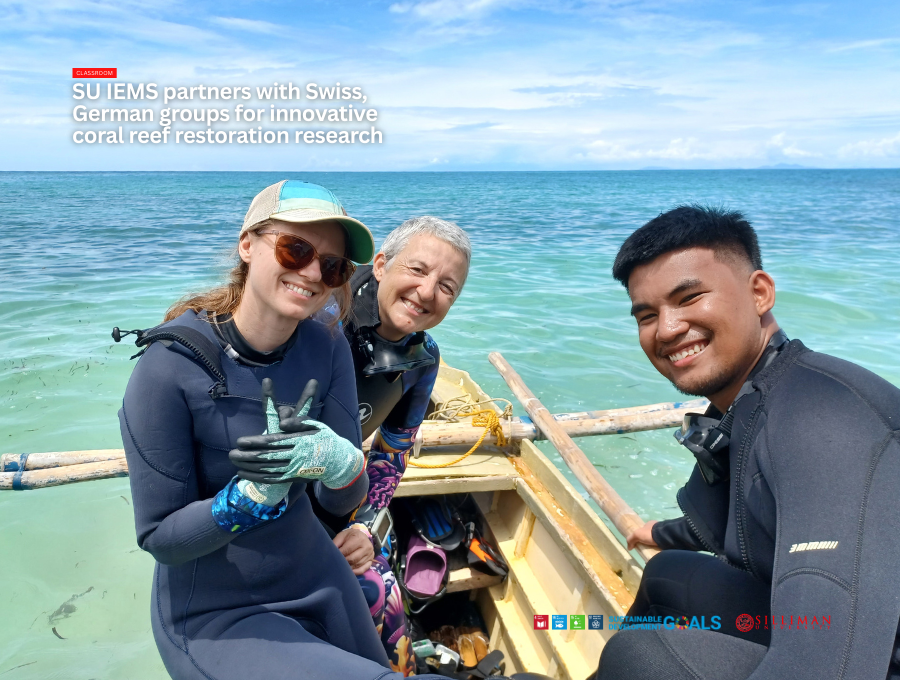
Jhon Reimer Fajardo (right), IEMS graduate student of MS Marine Biology; Hanna Kuhfuss, rrreefs head of Operations and Scientific partnerships (left); and Patricia Stockli (center) pose for a photo taken by Dr. Aileen P. Maypa.
Leading SU IEMS’ contribution is its director, Dr. Aileen P. Maypa, alongside graduate student Jhon Reimer Fajardo, who oversee assessments of fish diversity, abundance, and biomass in and around the reef system. The project also serves as a training platform for emerging marine scientists.
Maypa, a Pew Fellow in Marine Conservation, said the partnership aligns with her ongoing project, Accelerating Coral Reef Recovery and Function Through Science-Based and Community-Friendly Restoration Toolkits in the Philippines, which evaluates and refines effective coral restoration approaches.
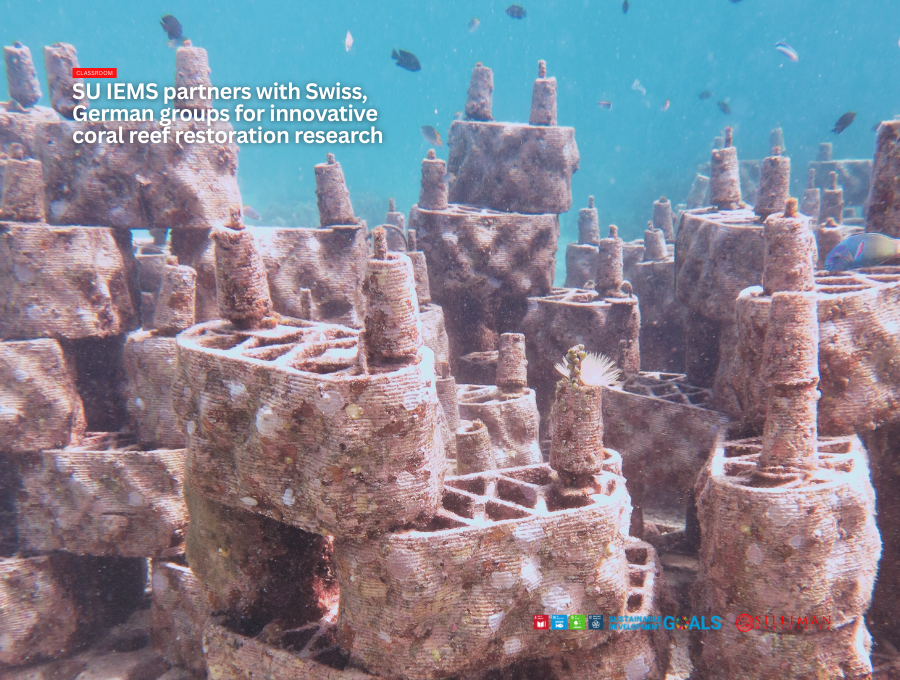
A one-year-old 3D printed clay reef deployed in Milalunan Marine Sanctuary, Maria, Siquijor Province. Hundreds of coral juveniles are now growing on it. (Photo: Dr. Aileen P. Maypa)
Beyond Siquijor, rrreefs is also implementing a larger 100-square-meter clay reef project in Pujada Bay, Davao Oriental, in collaboration with Davao Oriental State University (DORSU). The organization has supplied the university with 3D printers to support local production of clay modules and facilitate community-level technology transfer. rrreefs likewise works closely with the Department of Environment and Natural Resources (DENR) and the Bureau of Fisheries and Aquatic Resources (BFAR) to strengthen coral reef recovery efforts in the region.


