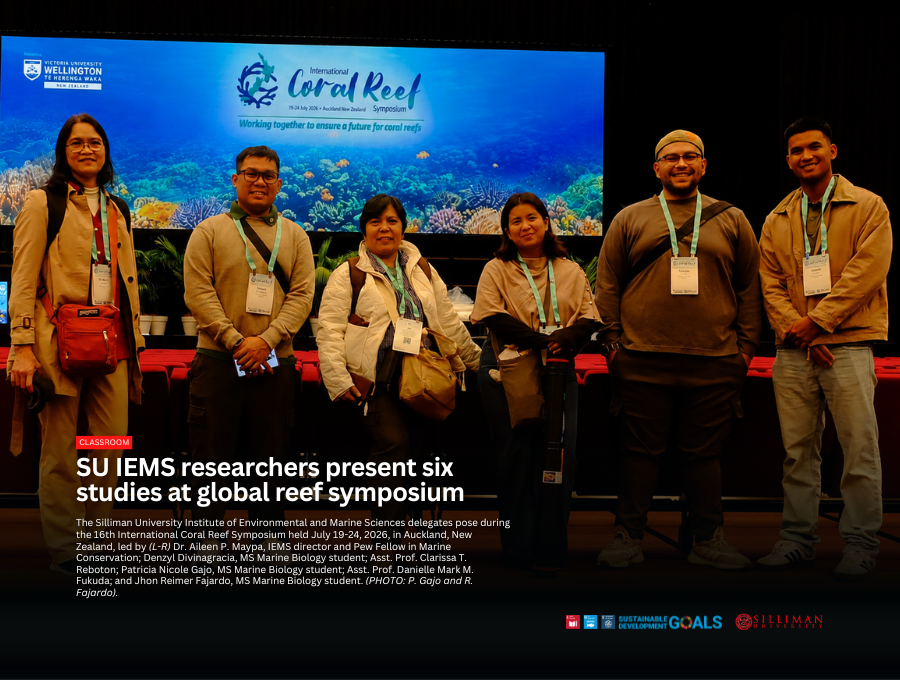
SU IEMS researchers present six studies at global reef symposium
Silliman University, through its Institute of Environmental and Marine Sciences (IEMS), presented six research studies on coral reef conservation and sustainable fisheries at the 16th International Coral Reef Symposium (ICRS), joining more than 2,100 scientists, conservation practitioners, and policymakers from 93 countries in Auckland, New Zealand, from July 19 to 24, 2026.
Held once every four years, the conference on coral reef science aims to exchange the latest scientific findings, conservation innovations, and collaborative strategies for protecting coral reef ecosystems.
IEMS faculty members and graduate students presented research studies highlighting SU’s ongoing contributions to advancing science-based coral reef conservation and sustainable fisheries management in the Philippines.
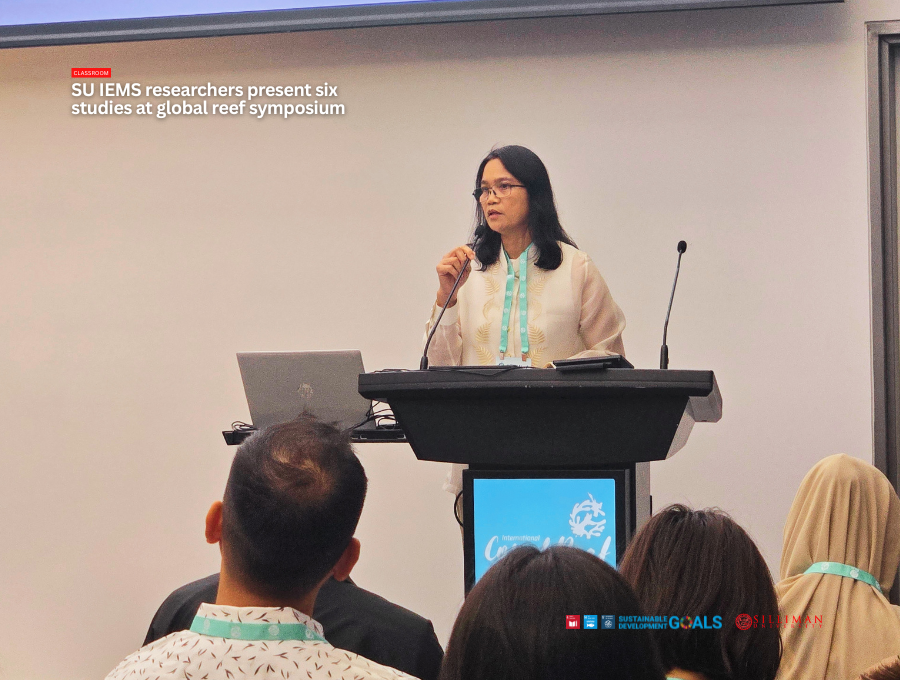
Dr. Aileen P. Maypa presents part of her research results from her Pew Fellowship in Marine Conservation Project. (PHOTO: JR Fajardo)
Dr. Aileen P. Maypa’s “Integrating Community Voices and Local Engagements Toward an Effective Coral Reef Conservation and Restoration Framework in the Philippines” proposed a Preventive Actions, Passive Restoration, and Active Restoration (PPAR) Framework, which places community engagement at the center of coral reef conservation and restoration.
Drawing from case studies in Bohol, Siquijor, and Negros Oriental between 2013 and 2025, the framework demonstrates how integrating local communities, governance, scientific research, and multi-sector partnerships can improve the long-term success of conservation efforts.
Maypa’s study reported that more than 600 hectares of coral reefs in the Central Philippines have been conserved or restored through community-centered approaches.
Asst. Prof. Clarissa T. Reboton’s “Rebuilding the Reefs: Coral Settlement Dynamics in Apo Island, Philippines, One and Six Years After the Devastation Caused by Typhoons Washi and Bopha” examined how coral reefs in Apo Island recovered following the devastation caused by Typhoons Washi and Bopha.
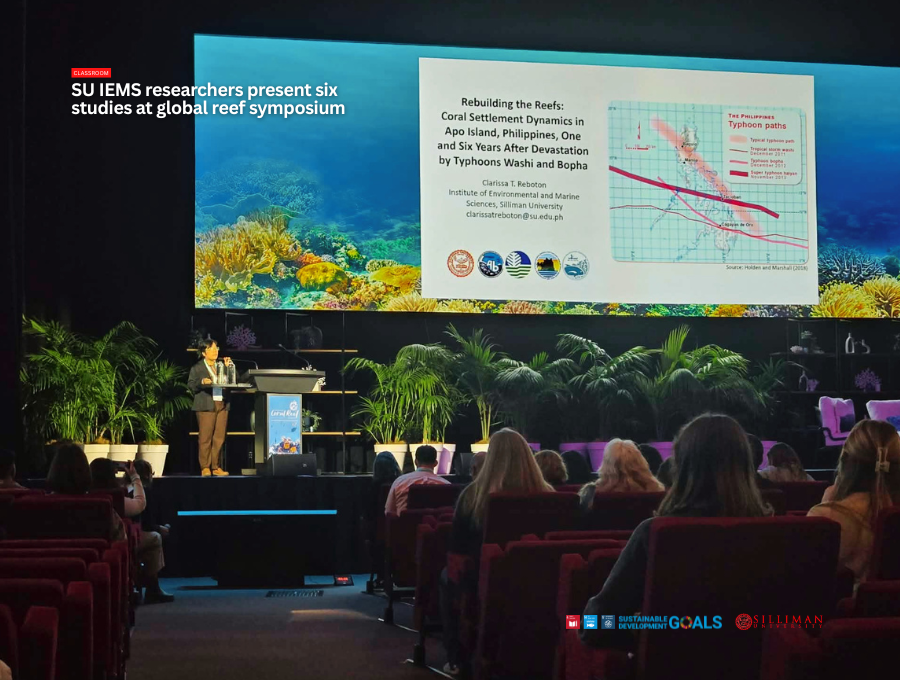
Asst. Prof. Clarissa T. Reboton presents her paper “Rebuilding the Reefs: Coral Settlement Dynamics in Apo Island, Philippines, One and Six Years After the Devastation Caused by Typhoons Washi and Bopha.” (PHOTO: DM Fukuda)
By comparing coral settlement one year and six years after the disturbances, Reboton’s study found substantial increases in coral recruitment at previously impacted sites, indicating encouraging signs of reef recovery while highlighting differences in recovery patterns among coral groups.
Meanwhile, Asst. Prof. Danielle Mark M. Fukuda’s “Preliminary Findings on the Sediment Dynamics at the Bantayan Artificial Reef Site, Dumaguete City, Philippines: Implications for Restoration Success” evaluated how seasonal sediment movement affects the stability and ecological performance of newly deployed artificial reef structures.
Early observations revealed that sediment accumulation during the southwest monsoon partially buried some reef domes, emphasizing the importance of site suitability and long-term environmental monitoring in ensuring successful reef restoration initiatives.
Complementing the faculty presentations were studies by IEMS graduate students focusing on sustainable fisheries in Central Philippines.
Patricia Nicole Gajo investigated the reproductive biology and gonadal maturity of Lethrinus harak in her study “Fecundity and Gonadal Maturity of Lethrinus harak (Forsskål, 1775), a Commercially Important Fish Species from Central Philippines.”
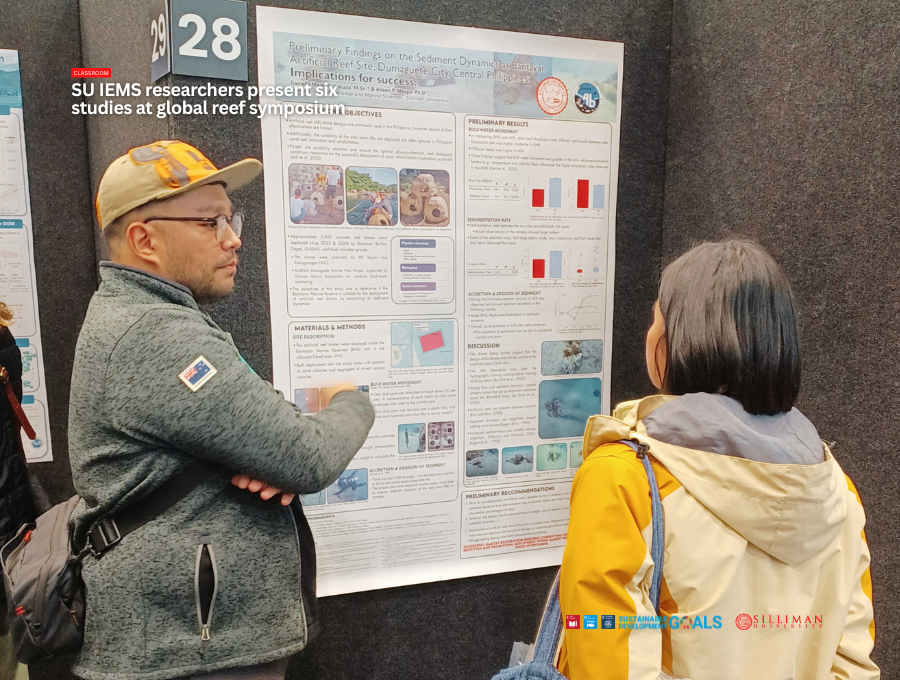
Asst. Prof. Danielle Mark M. Fukuda presents his research during one of two poster sessions. (PHOTO: JR Fajardo)
Jhon Reimer Fajardo examined the species’ growth dynamics in a data-limited coral reef fishery along the Dumaguete coast in his research “Assessing Growth Dynamics of Lethrinus harak in a Data-Limited Coral Reef Fishery in Dumaguete Coast, Central Philippines.”
Denzyl Divinagracia, meanwhile, presented research titled “Spawning Season and Batch Fecundity of the Indian Mackerel (Rastrelliger kanagurta) in Siquijor Province, Central Philippines: Implications for Sustainable Fisheries Management,” providing baseline information that can inform science-based fisheries management and conservation policies.
Participation in the symposium was made possible through the generous support of the Pew Fellowship in Marine Conservation Project of the PEW Fellow and IEMS director Maypa’s “Accelerating Coral Reef Recovery and Functionality.”
The international symposium featured approximately 13 parallel research presentation sessions from July 20 to 24, alongside two poster sessions held on July 20 and 22.
Discussions throughout the conference emphasized the growing urgency of science-based solutions and international collaboration in addressing the impacts of climate change on coral reefs and the communities that depend on them.
The Philippines was strongly represented by more than 60 coral reef researchers and practitioners from universities, non-government organizations, and national government agencies, including the Department of Environment and Natural Resources–Biodiversity Management Bureau (DENR-BMB).


