SU-IRS highlights research excellence at PPTA IMPETUS 2025
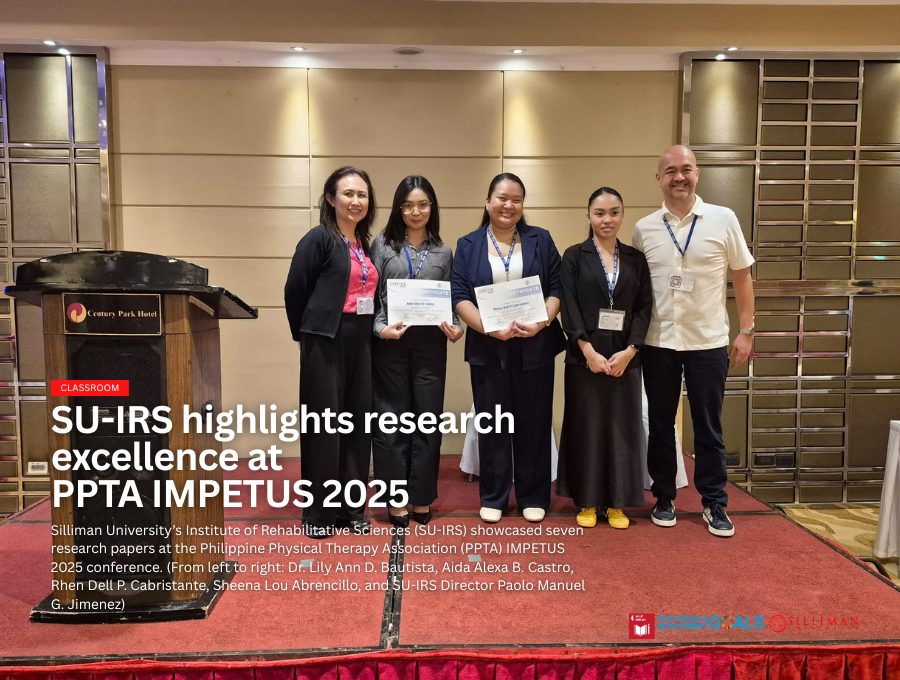
Silliman University’s Institute of Rehabilitative Sciences (SU-IRS) presented seven research studies at the Philippine Physical Therapy Association (PPTA) IMPETUS 2025, held on November 22–23 at Century Park Hotel, Manila.
SU also celebrated two national distinctions: Aida Alexi Bulahan Castro received the Exemplary Presenter Award, while Kirk Jeremiah Acuesta placed First Runner-Up in the poster competition. In addition, Ella Nazaria Vasquez contributed to the organization of the national event as OIC Vice President for Documentation of the Association of Philippine Physical Therapy Students (APPTS).
With the theme “PHYSICAL THERAPY 2030: Leading Inclusive, Integrated, and Innovative Rehabilitation,” the convention featured SU student researchers Joshua Paul Verdillo, Houria Mosqueda, Kenneth Andrei Vertulfo, Rhena Cabristante, Castro, Sheena Abrencillo, Acuesta, and Triza Puyod, who delivered studies spanning community rehabilitation, sports science, geriatric care, ergonomics, and AI-driven assessment.
Among the featured works was “Physical Therapists’ Teaching Strategies and its Relationship to Caregiver Satisfaction in Selected Outpatient Rehabilitation Clinics in Negros Oriental” by Abrencillo, Aida Alexi B. Castro, Amiel John A. Francisco, Jandwin Czar P. Plazos, Jihan Ashley M. Ramos, Sean Thomas T. Tan, and Demheinzie A. Villamin, which found that caregiver satisfaction increased significantly when therapists supplemented verbal instruction with written handouts.
Community health was also spotlighted in “Knowledge, Attitude, and Practices of Barangay Health Workers Towards Physical Therapy Services in Selected Barangays of Manjuyod, Negros Oriental and its Relationship to their Demographic Profile” by Cathlyn E. Baligasa, Klein Fitzgerald K. Caballo, Cabristante, Carlyle Anne L. Claros, Kate Florida Daeñelle B. Dagle, Emmilche Rhicedth Elsberry, Lady Sushmita F. Tabuñag, and Carl Jefrey E. Yatar, which showed positive attitudes but neutral knowledge and practices among BHWs, with no demographic predictors.
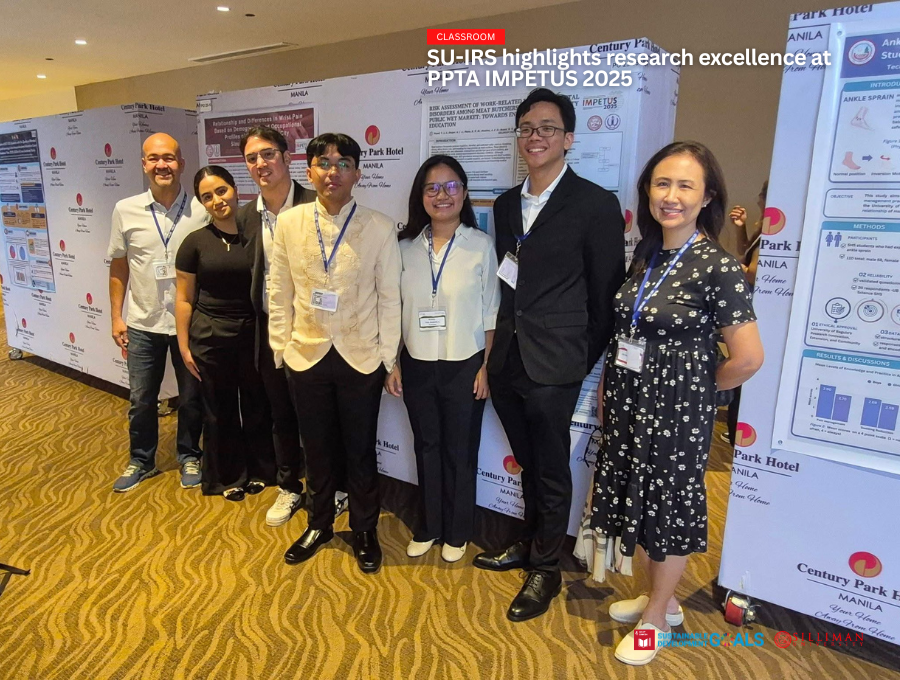
SU-IRS student researchers did both platform and poster presentations. (From left to right: Dr. Paolo Manuel G. Jimenez, Houria Mosqueda, Kenneth Andrei Vertulfo, Kirk Jeremiah P. Acuesta, Triza Anabelle S. Puyod, Joshua Paul T. Verdillo, and Dr. Lily Ann D. Bautista)
Research in sports performance was represented in “The Correlation Between Hamstring Flexibility and Vertical Jump Performance Among Volleyball Players in Selected Schools in Dumaguete City” by Geah Brylle E. Abadilla, Maria Patricia T. Cayongcong, Raul Miguel C. Eran, Charynna Zoe C. Lorico, Alesie Mitz G. Sarvida, and Vertulfo, which found that sex significantly influenced jump height, while flexibility and BMI did not.
In geriatrics, “Perceived Fear of Falling and Fall Risk Performance Among Older Adults in Select Barangays in Dumaguete City” by Gabriel V. Flores, Tanya Maureen A. Leon, Dominic Cecilio V. Managbanag, Jenicka Lyra M. Monares, Mosqueda, Anna Angela M. Palacios, Ira Gabriel A. Prado, and Aliyah Krista J. Tilos reported no significant relationship between fear of falling and actual fall risk, although older adults with previous falls exhibited higher fear levels.
Innovation in rehabilitation was highlighted in “Comparing the Interrater Reliability of SOMA to Traditional Methods and Video Observation for Functional Movement Screen Scoring and Compensatory Movement Identification” by Verdillo, Ashley Atasha A. Al-os, Evriel Prince F. Apura, Daryl Reymon S. Apla-on, Russel James E. Balane, Tanya Mariel P. Capilla, NJ M. Ermina, and Ressyl Love S. Salvador, which demonstrated fair to almost perfect agreement between SOMA’s AI-driven assessments and human raters.
Ergonomics studies also contributed significantly: “Risk Assessment of Work-Related Musculoskeletal Disorders Among Meat Butchers in Dumaguete City Public Wet Market: Towards Enhanced Ergonomic Education” by Neil Jasper A. Draper, Kirsty Haniela M. Panes, Puyod, Arianne Frances D. Ramirez, Nick Vincent S. Reasol, Ramonah Jacinth Q. Retada, Nephi Marie S. Torres, and Janelle Louise N. Valente revealed uniformly high ergonomic risk due to repetitive and forceful tasks, while “Relationship and Differences in Wrist Pain Based on Demographic and Occupational Profiles of the Dumaguete City Slaughterhouse Workers” by Acuesta, Cheska Ysabel M. Cheng, Gene III E. Duran, Gio Rico N. Escona, Marc Daniel A. Fernandez, Luiz Paul C. Machon, Glory Grace Y. Opsima, Monica P. Quinanola, and Charles Marion O. Torremocha found wrist pain consistently present across workers regardless of demographic or job factors.
Together, these studies reflect SU-IRS’s strong research culture and its commitment to evidence-based, community-responsive rehabilitation practice at both local and national levels.


