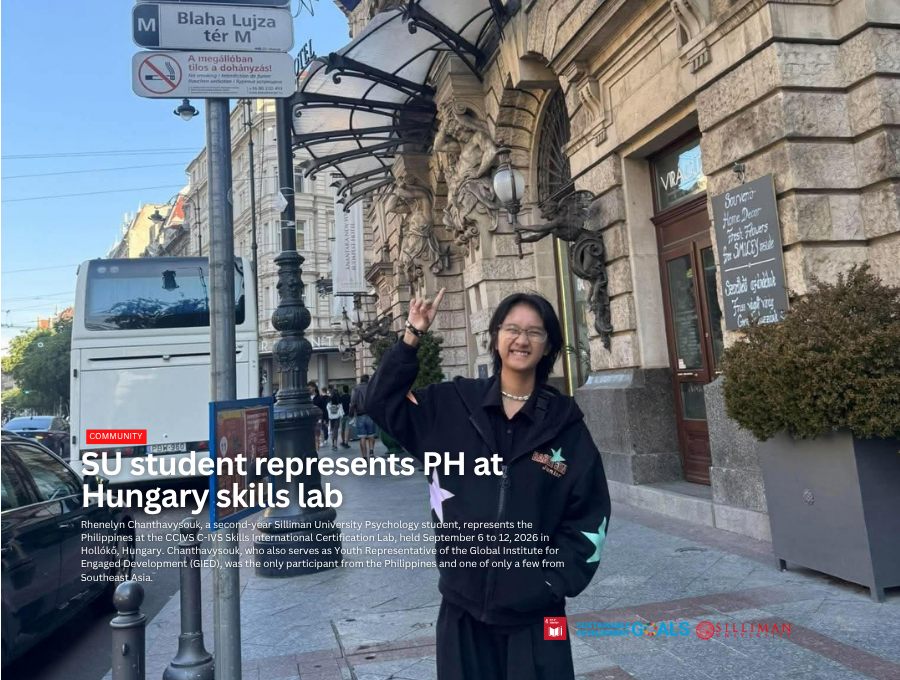
SU student represents PH at Hungary skills lab
A Silliman University (SU) student represented the Philippines at an international workshop in Hungary aimed at developing a global framework for recognizing skills gained through volunteer work.
Rhenelyn Chanthavysouk, a second-year Psychology student and Youth Representative of the Global Institute for Engaged Development (GIED), joined the Coordinating Committee for International Voluntary Service (CCIVS) C-IVS Skills International Certification Lab, held September 6 to 12, 2026 in Hollókő, Hungary. She was selected through a competitive application process as one of very few participants from Southeast Asia and the only representative from the Philippines.
The lab gathered International Voluntary Service (IVS) activists from around the world to develop a certification framework recognizing competencies gained through international volunteer work.
Chanthavysouk said the initiative addressed a gap she experienced firsthand. After her first international workcamp in South Korea, she struggled to explain to scholarship committees and academic institutions what the experience had taught her.
“Before the C-IVS Lab, I wasn’t sure how to communicate the skills I gained from IVS to employers, universities, or institutions,” she said. “Volunteering had shaped me in ways I felt deeply but couldn’t always put into words on a CV or application.”
Participants began by mapping their own volunteer journeys on a “Wall of Change,” reflecting patterns CCIVS research has documented across more than 100 workcamp participants, including increased confidence and civic engagement.
They then refined the draft skills framework, debating whether “teamwork” should become “collaboration” and how to separate gender, diversity, and inclusion into distinct categories.
“The terminology we use in the framework must be universally understood and inclusive, not just for those who already speak the language of NGOs or international development,” Chanthavysouk said.
The group also conducted field interviews with local and international volunteers to test whether the framework’s language accurately reflected how people described their own skills.
In the lab’s final sessions, participants mapped out the certification process and developed outreach strategies for governments, universities, and the private sector.
Chanthavysouk said she plans to bring the framework back to SU and the Philippine volunteer community, with the goal of having it recognized by local universities and government agencies.
“I want to help create pathways where Filipino volunteers, especially those from marginalized communities, can have their learning recognized and valued,” she said. “Volunteering should not be invisible on a transcript or a resume. It is real learning, and it deserves to be treated as such.”
As part of her post-lab commitments, Chanthavysouk is expected to disseminate the C-IVS framework within the Philippine volunteer community, present it to at least one academic or government institution, and submit a report to CCIVS on its reception. She said she plans to bring a formal presentation to SU’s Office of Student Affairs and Services and to the Philippine National Volunteer Service Coordinating Agency (PNVSCA).
The C-IVS framework builds on the existing Volunteer Rights Framework and incorporates decolonial and inclusive approaches designed to serve young people from marginalized backgrounds.
Story by Jasper Dominic Miranda, photo by Rhenelyn Chanthavysouk


