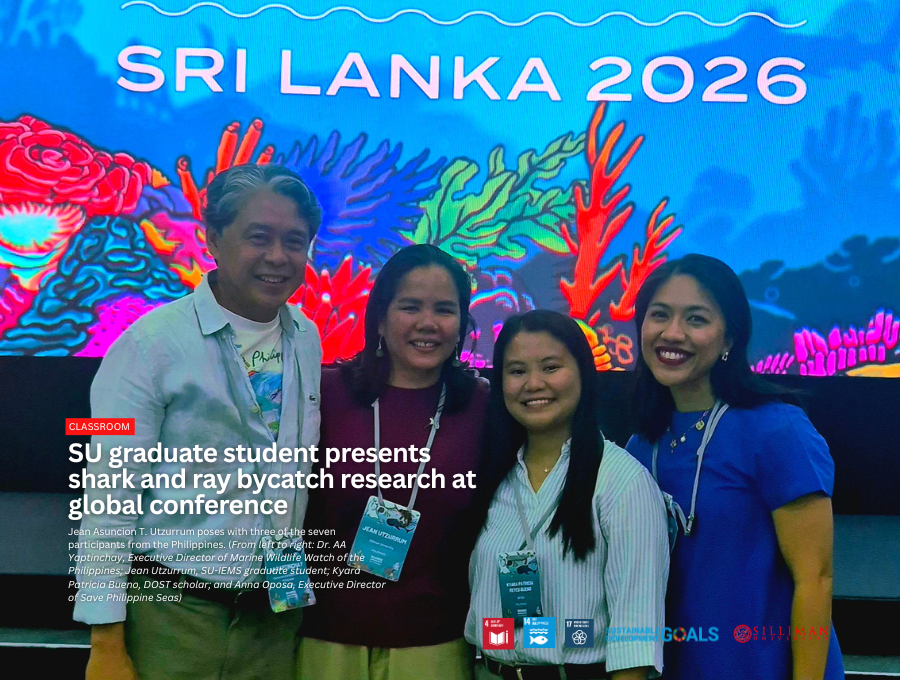
SU graduate student presents shark and ray bycatch research at global conference
Silliman University (SU) graduate student Jean Asuncion T. Utzurrum co-authored and presented a research study on shark and ray bycatch in Philippine small-scale fisheries during the 5th Sharks International Conference 2026, the world’s largest global gathering of scientists and conservationists working on shark, ray, and chimaera research and conservation, held May 3 to 8, 2026 at the Bandaranaike Memorial International Conference Hall in Colombo, Sri Lanka.
Held for the first time in Asia, Sharks International 2026 gathered more than 800 participants from 84 countries and featured over 600 oral and poster presentations focused on advancing science-based conservation solutions for threatened marine species.
Utzurrum, a Master of Science in Marine Biology student under the SU Institute of Environmental and Marine Sciences (IEMS), presented the poster titled “Shark and ray bycatch in Philippine small-scale fisheries,” which she co-authored with Elson Q. Aca and A.A. Yaptinchay. The presentation was part of Poster Session A held on May 4 and 5.
The study examined shark and ray bycatch in small-scale fisheries across three regions in the Philippines using semi-structured interviews and opportunistic landing and market surveys. Researchers documented 32 fishing gear types, 22 of which were associated with shark and ray bycatch. The study identified at least 24 bycatch species, including 15 classified as threatened by the International Union for Conservation of Nature (IUCN) and 11 listed under the Convention on International Trade in Endangered Species (CITES).
Findings highlighted the vulnerability of sharks and rays to fishing activities in the Philippines and underscored the need for improved bycatch management strategies to help prevent further population declines.
The research presented at the conference formed part of Utzurrum’s work as a shark and ray specialist for the non-government organization Marine Wildlife Watch of the Philippines.
Prior to the formal opening of the conference, Utzurrum also attended a pre-conference workshop on “Maximising the potential of elasmobranch strandings” organized by the Zoological Society of London’s Ocean Predator Lab. The workshop provided additional training that may contribute to strengthening the stranding response capacity of SU-IEMS.
Reflecting on the experience, Utzurrum shared that being among only seven Filipinos attending the conference underscored both the importance and urgency of shark and ray conservation work in the Philippines.
“This was my first time attending Sharks International in person. To be one of seven Filipinos in attendance among 800+ participants, and representing a country with possibly close to 200 species of sharks, rays, and chimaeras in its waters including endemic species like the Philippine guitarfish, really emphasized how important our work in the Philippines is and how much more work can still be done to ensure their survival in the wild,” she said.


